Urban Mining: Boosting Cost Stability and Material Security


European companies are entering a period of heightened pressure. Dependence on imported raw materials, volatile prices and new regulatory requirements such as the Critical Raw Materials Act (CRMA) are transforming resource security from an operational issue into a strategic concern. While many organizations optimize procurement and recycling, a major opportunity often remains overlooked: the valuable materials already embedded in products and equipment that are circulating today.
The Hidden Potential of the Urban Stock
Studies indicate that the quantities of critical and precious materials contained in Europe’s electronics already rival those of primary mining deposits. Large amounts of gold, silver, copper, cobalt and rare earth elements remain locked in devices that are unused, returned or disposed of. Annual electronic waste streams contain metal values worth tens of billions of euros, yet much of this value is lost due to insufficient return flows, lack of targeted dismantling and missing recovery processes. Organizations that strategically access these “urban deposits” gain direct access to high-quality materials while reducing waste and external dependencies.
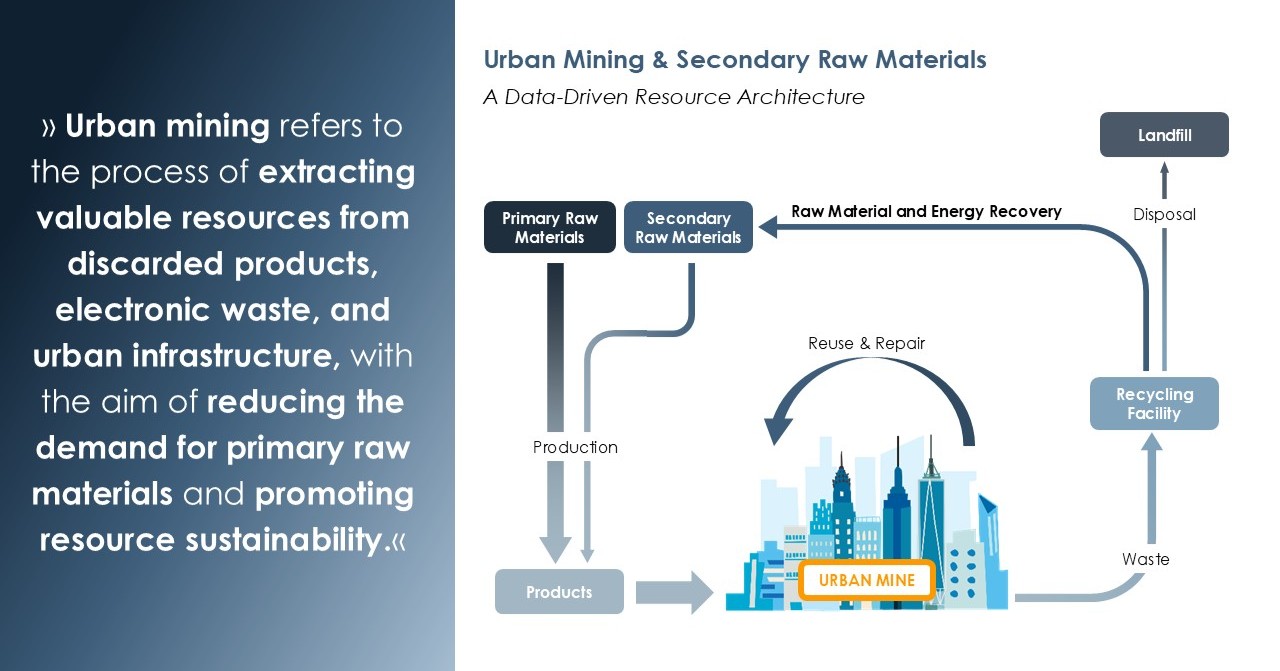
Why Urban Mining Makes Economic Sense
The economic logic has strengthened considerably. Volatile prices for key raw materials, increasing geopolitical risks and regulatory pressure to reduce dependency all raise the value of secondary sources. Importantly, materials extracted from discarded devices often meet higher quality requirements than mixed secondary materials from traditional recycling plants. For sectors like electronics, machinery or telecommunications Urban Mining becomes a financially attractive alternative to virgin or low-grade recycled materials. Urban Mining therefore offers ecological benefits, but its primary value lies in cost stability, supply security and compliance with emerging regulatory expectations.
Electronics as a Strategic Hotspot
PCBs (Printed Circuit Boards) and electronic modules contain high concentrations of valuable metals. Some boards hold up to fifty times more gold per tonne than conventional mining ore. Despite this potential, three gaps persist:
- Limited return and collection mechanisms
- Missing automated systems to assess the value of components
- Lack of standardized, economically scalable dismantling and recovery processes
Closing these gaps opens the door to entirely new business models and circular value streams.
KIBARtronik as a Practical Blueprint
The KIBARtronik research project demonstrates how an integrated Urban Mining approach can be operationalized in the electronics sector. By combining AI-based optical inspection, digital product data and structured return processes, the system identifies which components in returned devices still hold functional or material value.
Three contributions stand out:
- Transparency into the true condition of modules such as routers, IoT devices and PCBs
- AI models that determine residual value at component level and make it economically usable
- Analysis of logistics and process models that enable scalable recovery and reintegration into value chains
KIBARtronik therefore shows how Urban Mining evolves from manual assessment to a technology-enabled, data-driven resource strategy.
Why Urban Mining Becomes a Core Field for Chief Sustainability Managers (CSM)
Integrating Urban Mining is not a technical add-on, it affects procurement, product development, operations and sustainability alike. For CSMs, this shifts Urban Mining into a strategic leadership domain. Key responsibilities include:
- Mapping the company’s internal “urban material flows”
- Evaluating economically attractive recovery pathways
- Integrating return logistics into supply chain structures
- Collaborating with engineering teams to improve design for dismantling and reuse
- Navigating requirements from ESPR (Eco-Design for Sustainable Products Regulation), CRMA and related regulations
- Prioritizing Urban Mining actions that deliver measurable business value
A CSM who anchors Urban Mining strategically contributes directly to supply resilience, reduced exposure to geopolitical risks and long-term cost advantages.
Conclusion
Urban Mining is no longer a niche sustainability concept, it is a necessary extension of modern resource strategies. Companies that treat legacy devices as valuable material reservoirs and implement data-driven systems for their assessment and recovery gain a structural advantage. KIBARtronik illustrates how this shift can succeed in practice and how Urban Mining becomes a lever for economic stability, not just environmental performance.
.png)
Let's connect!
Are you ready to make Urban Mining part of your strategy? Connect with us.
Subscribe to receive the latest insights directly to your inbox.


%20(1).jpg)
%20(13).jpg)

%20(15).jpg)

%20(6).jpg)